


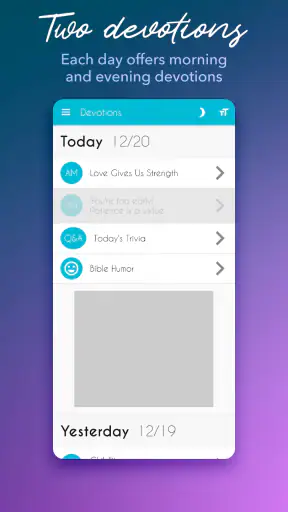

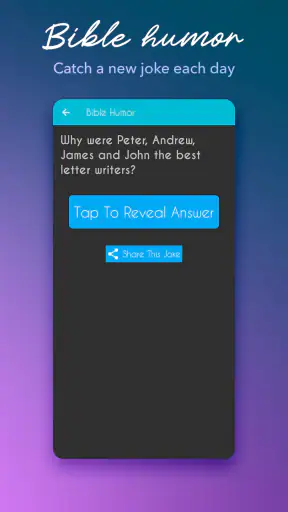
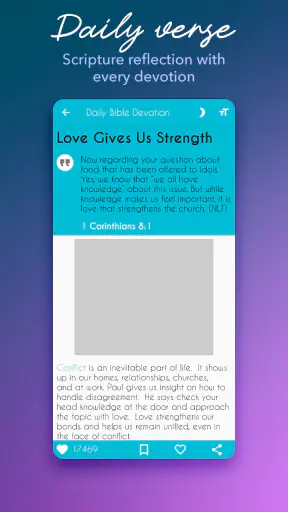
I found Daily Bible Devotion & Prayer most useful when I treated it as a small daily pause rather than as a complete Bible study replacement. The app sits in the Books & Reference category, and Salem Media Group has built it around short devotional reading, Bible verses, prayer, and encouragement. That focus makes it approachable: I can open it when I have only a few minutes, read one thought, and leave with something specific to reflect on.
That simplicity is also the key to deciding whether it belongs on your phone. If you want a gentle routine that helps you remember to read Scripture and pray, it has a clear purpose. If you expect a full research Bible with extensive study tools, multiple translations, or a deep reference library, I would look elsewhere. My overall impression is that the app works best as a daily spiritual companion, not as an all-purpose digital Bible.
How the reading experience supports different users
Readable devotionals for short, focused sessions
The daily format is easier to approach than a large library of passages. Instead of deciding where to begin in a long Bible, I can open the app and start with the featured devotional material. That removes a common obstacle for beginners: having access to Scripture but no idea how to turn that access into a regular habit.
I also like the way a short reading can fit around ordinary routines. A person could use it before work, during a quiet lunch, or just before bed without committing to an extended study session. The content is especially suitable for readers who prefer one central idea at a time. It gives the mind a clear starting point rather than presenting an overwhelming wall of references.
For users with attention difficulties, that limited scope may be helpful. A brief devotional can feel achievable on a distracted day, and completing a small reading is often more realistic than planning an ambitious study session. The trade-off is that readers who want long explanations may find the experience too compact. I would not choose it as my only resource when I need detailed historical context, word studies, or a systematic reading plan.
Navigation that favors routine over research
The app’s purpose is easy to understand from the first use: open it, read the devotional, consider the verse, and spend time in prayer. That straightforward flow is friendlier than a reference-heavy interface filled with parallel passages and technical tools. Someone new to devotional apps should not need specialist knowledge to understand what to do next.
There is a subtle advantage here for older users or anyone who becomes frustrated by complicated menus. A focused daily experience reduces the number of decisions required. I can return to the same basic pattern instead of learning a large collection of study functions. For a family member who wants encouragement rather than research, that may matter more than having every possible Bible feature in one place.
At the same time, a simpler structure can feel restrictive to experienced readers. When I want to compare interpretations or move quickly between several passages, a dedicated Bible app is usually more efficient. Daily Bible Devotion & Prayer is better at guiding attention than at supporting open-ended investigation. That distinction is important because the same simplicity that helps one user can slow down another.
Text comfort matters more than the app’s promise
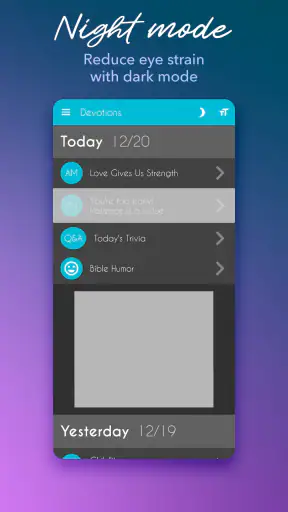
Reading comfort depends heavily on the phone, operating-system settings, and the way each screen presents its text. I would test the app with the device’s preferred display settings before settling into a routine. Users who need larger text, stronger contrast, or reduced visual clutter should check whether the devotional remains comfortable at their chosen settings rather than assuming every screen will adapt perfectly.
A useful personal workflow is to read in a quiet place with the screen brightness adjusted before beginning. That sounds basic, but devotional reading is more reflective when I am not squinting or fighting glare. If a user relies on magnification or a screen reader, the practical question is whether every important control and reading element is announced clearly on that particular device. I would verify that directly during the first session, especially before recommending it to someone who depends on assistive technology.
The app is free to download, which lowers the barrier to trying it. Optional in-app items range from one dollar to nineteen dollars and ninety-nine cents each, so I would review any purchase prompt carefully and avoid assuming that every part of the experience is included without cost. The free entry point is welcome, but financial clarity still matters for users who need to keep phone spending tightly controlled.
Motor and sensory considerations in everyday use
For someone with limited dexterity, a short devotional routine can be less demanding than a complex study workflow because it does not require constant movement through many reference panels. Still, the comfort of using it depends on the size and placement of on-screen controls. I would use the app with the phone positioned securely, rather than trying to operate it while walking, carrying groceries, or managing another task.
That point is especially relevant for people with tremors or reduced precision. A focused reading app may reduce the number of taps, but it does not automatically solve small-target problems. If a user finds a particular control difficult to activate, the app may become tiring even though the reading itself is accessible. A larger device or operating-system interaction setting could make the experience more manageable, but the result will vary from one phone to another.
Users sensitive to bright screens or visual stimulation may prefer a calm environment and a lower brightness level. I would also avoid treating the app as a good choice for every sensory context. Reading during a noisy commute, in direct sunlight, or while multitasking can make reflective content harder to absorb. The material may be short, but meaningful attention still requires suitable surroundings.
For people who process information slowly, the daily structure offers a useful advantage: there is no need to rush through a large chapter. I can read a sentence, pause, and return to the thought without feeling that I have fallen behind a schedule. On the other hand, anyone who needs audio-first access, highly adjustable typography, or very explicit navigation should test those needs personally. I would not promise a fully effortless experience for every assistive setup.
A realistic morning routine
My most practical use case is a weekday morning when I have a few minutes before starting work. I open the app with coffee, read the daily devotional, look at the related verse, and use the prayer section to name one concern for the day. I do not try to turn that moment into a full study session. The value comes from having a repeatable sequence that is small enough to keep even when the morning is busy.
This routine can also suit someone returning to faith after a long break. A large Bible can feel intimidating, particularly when the reader is unsure which book to choose or how much to read. A daily devotional provides a softer entry point. It does not require the user to know theological vocabulary or create a complicated plan before beginning.
For a caregiver, the same format could work during a quiet interval, provided the phone is easy to operate and the surrounding environment is not too distracting. For a student, it may fit better as a short evening reset than as another task squeezed into an already crowded morning. The app’s strength is flexibility of timing, not a special solution for any one lifestyle.
Situational access when attention and connectivity are limited
Daily Bible Devotion & Prayer makes the most sense when I can give the screen a little attention. It is not something I would use while driving, crossing a street, or handling equipment. The short format may encourage quick checking, but the content deserves a safe and settled moment. A user who needs hands-free access should confirm that the phone’s own accessibility tools provide a comfortable way to interact with the reading.
Travel and weak connectivity are also situations worth considering before depending on it as a sole devotional resource. I would prepare by opening the app in advance and checking what remains available if the connection changes. If uninterrupted offline reading is essential, I would keep a separate downloaded Bible or printed material as backup rather than assuming a devotional app will cover every travel situation.
That is one area where a conventional Bible app or a physical book may be the better alternative. A printed Bible does not require battery power, screen adjustments, or touch interaction. A full-featured Bible app may offer stronger search and cross-reference tools. Daily Bible Devotion & Prayer wins when the priority is an uncomplicated daily prompt, not when the priority is independence from a phone or comprehensive research.
What the app does not replace
I would be careful about expecting the devotional format to answer difficult questions. A short reflection can encourage prayer, but it is not the same as a commentary, a study Bible, or a conversation with a trusted teacher. Readers working through complex passages may need another resource beside it. Using this app as a starting point rather than an authority for every question leads to a more realistic experience.
It is also not automatically the best option for users who want a large set of customization tools. People who need carefully controlled text presentation, extensive audio support, or rapid navigation across many books should compare it with specialist Bible and reading apps. The fact that it is rated for Everyone makes it approachable for a broad audience, but an age label does not describe every person’s accessibility needs or guarantee a perfect fit for every device.
Scale, maintenance, and practical expectations
The app has been available since July 18, 2011, and its current version is 7.0.2. That long presence suggests a product intended for an ongoing audience rather than a short-lived experiment. It has reached over five million installs, with an average rating of 4.6 from around fifty thousand ratings and roughly nine thousand four hundred reviews. Those figures tell me that many people find the format useful, although popularity cannot replace checking whether its reading style suits an individual user.
Salem Media Group is the developer, and the app remains free to start. The combination of a long-running product, a familiar daily structure, and a low initial cost makes it easy to try without making a major commitment. I would still keep expectations grounded: longevity does not mean every screen will suit every accessibility setup, and a strong average rating does not guarantee that the devotional tone or navigation will match everyone’s preferences.
The minimum operating-system requirement is Android 7.0. For someone using an older phone, that requirement is worth checking before planning a shared family installation. On a supported device, I would spend the first few minutes exploring the reading flow, prayer area, and any settings or purchase prompts. That small inspection can reveal whether the app works comfortably with the user’s text size, touch habits, and visual preferences.
Who should choose it, and who should skip it
I would recommend it to a reader who wants a manageable daily prompt, appreciates devotional encouragement, and does not want to build a study plan from scratch. It is also a sensible choice for someone testing whether a regular Bible-reading habit can fit into an ordinary day. The free starting point makes experimentation easy, while the short format reduces the pressure that often causes new routines to fail.
I would be more cautious about recommending it to a user whose main goal is scholarly study, offline independence, or highly specialized accessibility. In those cases, a dedicated Bible reference app, an audio-focused tool, or a physical Bible may be more appropriate. Someone who dislikes devotional commentary and wants only a searchable text will probably find the app’s guided approach unnecessary.
For families, I would introduce it as an optional shared habit rather than a compulsory schedule. One person might enjoy the daily reflection while another prefers reading directly from a chosen Bible translation. That difference does not mean the app is failing; it simply shows that devotional guidance and open-ended Bible reading serve different needs.
My inclusive verdict after using the daily format
Daily Bible Devotion & Prayer succeeds because it lowers the effort needed to begin. Its strongest accessibility quality is not a particular technical promise but the way it narrows the task to a short, understandable moment of reading and prayer. That can support beginners, busy adults, older readers comfortable with a phone, and anyone who benefits from a gentle routine.
Its limitations are equally clear. The experience may not satisfy people who need deep study tools, extensive control over presentation, or guaranteed comfort with assistive technology. Users with motor, visual, hearing, or cognitive needs should test the actual interface on their own device and adjust their phone settings before relying on it daily. If the controls or text do not cooperate with those needs, a different format is the kinder choice.
My final recommendation is therefore conditional but positive: try it if you want a simple devotional companion and can read comfortably on your phone. Keep a fuller Bible resource nearby for research, and keep a non-phone alternative if connectivity, battery life, or touch interaction could interrupt your routine. With those expectations, Daily Bible Devotion & Prayer offers a welcoming starting point for a daily faith practice without pretending to be every kind of Bible tool at once.


